Normally, an array is a collection of similar type of elements which has contiguous memory location.
Java array is an object which contains elements of a similar data type. Additionally, The elements of an array are stored in a contiguous memory location. It is a data structure where we store similar elements. We can store only a fixed set of elements in a Java array.
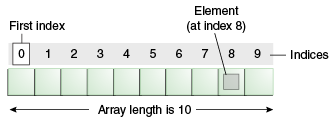
Array in Java is index-based, the first element of the array is stored at the 0th index, 2nd element is stored on 1st index and so on.
Unlike C/C++, we can get the length of the array using the length member. In C/C++, we need to use the sizeof operator.
Advantages
- Code Optimization: It makes the code optimized, we can retrieve or sort the data efficiently.
- Random access: We can get any data located at an index position.
Disadvantages
- Size Limit: We can store only the fixed size of elements in the array. It doesn’t grow its size at runtime. To solve this problem, collection framework is used in Java which grows automatically.
For-each Loop for Java Array
We can also print the Java array using for each loop. The Java for-each loop prints the array elements one by one. It holds an array element in a variable, then executes the body of the loop.
The syntax of the for-each loop is given below:
- for(data_type variable:array){
- //body of the loop
- }
Let us see the example of print the elements of Java array using the for-each loop.
- //Java Program to print the array elements using for-each loop
- class Testarray1{
- public static void main(String args[]){
- int arr[]={33,3,4,5};
- //printing array using for-each loop
- for(int i:arr)
- System.out.println(i);
- }}
Output: 3
An array is a container object that holds a fixed number of values of a single type. The length of an array is established when the array is created. After creation, its length is fixed.
 Site Title